How to Mail Film to a Lab: The Complete Guide to Mail-In Film Developing
So You Shot a Roll of Film. Now What?
First of all, welcome. Whether this is your very first roll or your five hundredth, that feeling of finishing a roll and wondering what’s on it never gets old. We love that part.But here’s where a lot of people get stuck. You’ve got a roll (or ten) of exposed film sitting on your desk, and you’re thinking: How do I actually get this developed? If you don’t have a local film lab nearby, or even if you do, mailing your film to a professional lab is one of the easiest and most reliable ways to get beautiful scans back. Photographers all over the world ship their film to labs every single day. It’s way less scary than it sounds, and we’re going to walk you through the whole thing.
Why Mail Your Film to a Professional Lab?
Let’s be real, you have options. Drugstores, local one-hour labs, even developing at home if you’re feeling adventurous. But here’s why so many photographers choose to mail their film to a dedicated lab:
Consistency. A professional film lab runs your negatives through calibrated machines with trained technicians who actually care about your images. That means your colors, density, and exposure are handled with intention and not just run through an automated machine at the pharmacy counter.
Scanner quality. Professional labs use high-end scanners like the Fuji Frontier SP-3000 and Noritsu HS-1800. These aren’t the same scanners you’ll find at a retail store. The difference in color, detail, and file quality is night and day.
Scan corrections. This is a big one. At a drugstore, your scans are auto-corrected by software. At a professional lab, you can get pro corrected scans where a real human adjusts each frame for color and density. That’s the kind of attention your images deserve.
Film handling. Your negatives are irreplaceable originals. A professional lab treats them that way with careful processing, proper sleeving, and safe return shipping.
How Mail-In Film Developing Works (Step by Step)
Alright, let’s break it down. The process is simple, and once you’ve done it once, it becomes second nature.
Step 1: Place Your Order Online
Before you put anything in a box, you’ll want to place your order through your lab’s website. At Indie Film Lab, you head to our “Send Film” page and enter the details for each roll you’re sending:
• Film size (35mm, 120, large format, etc.)
• Whether you need push processing (and how many stops)
• Your scanner preference (if applicable)
• Scan correction level
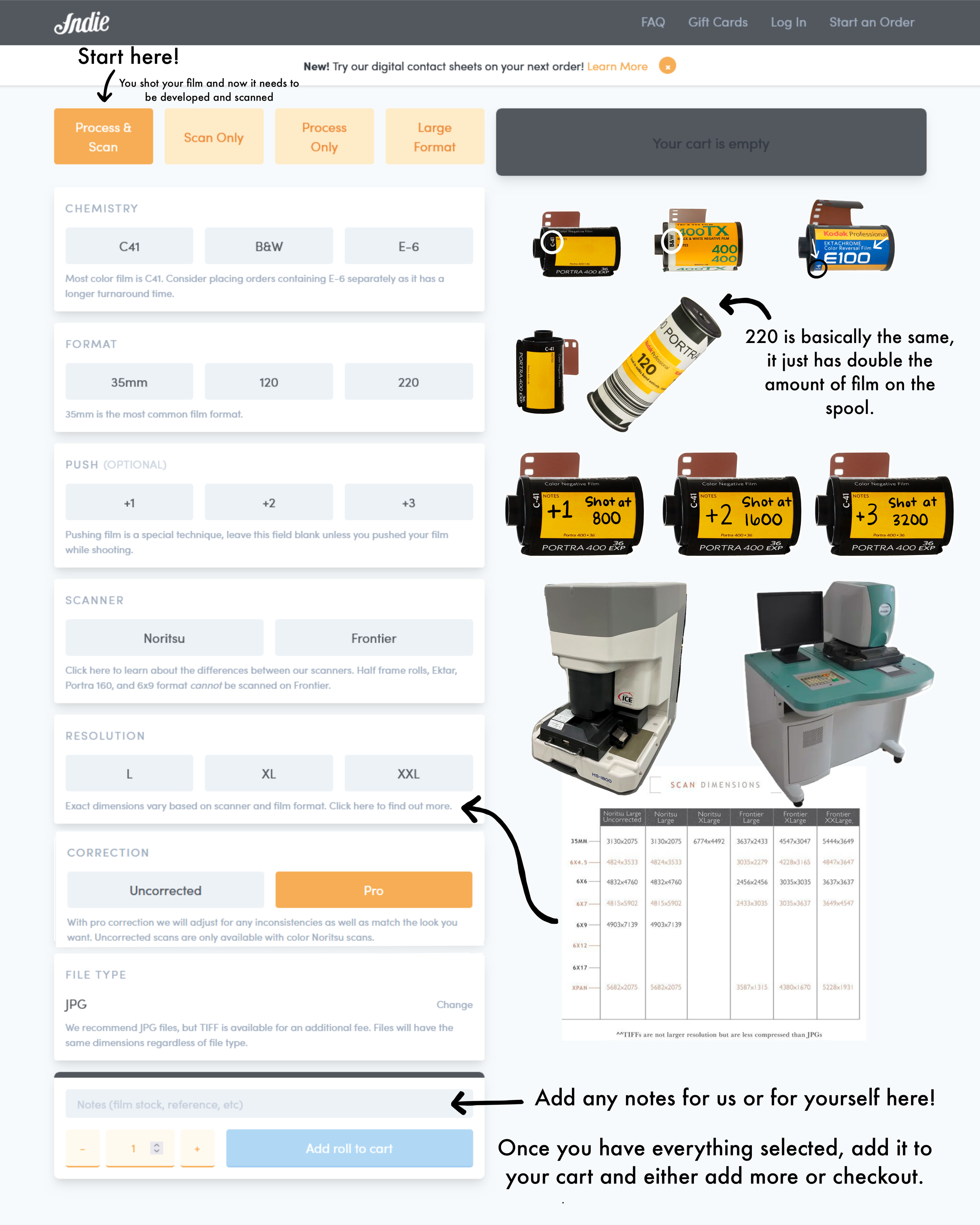
Ordering Cheat Sheet!
If you ever have any questions about placing an order please email or call us, we are happy to walk you through the steps!
Once the order is placed it will generate an order form that you’ll print and include with your film. This step is required! Film that shows up without an order form has to sit and wait until we can match it up, and nobody wants that.
Step 2: Pack Your Film
Here’s where people overthink it. Packing film for shipping is easy:
• Use a padded mailer or small box. A bubble mailer works great for a few rolls but make sure everything is properly sealed. If you’re sending a bigger batch, a small flat-rate box is the move.
• Keep your rolls together. Rubber band them or put them in a small bag so they don’t rattle around.
• Include your printed order form. Fold it up and tuck it in with your film. Write your name on the outside of your package too, just in case.
• Don’t stress about X-rays. USPS mail does go through X-ray machines, but standard screening won’t affect film under ISO 800. If you’re shipping ISO 800 or higher, a lead-lined bag gives you extra peace of mind, but for most film it’s a non-issue.
That’s it. No special containers needed. No hazmat procedures. Just your film, your order form, and some bubble wrap love.
Step 3: Ship It
Drop your package at the post office or schedule a pickup. USPS Priority Mail is the most popular option. It’s affordable, trackable, and usually arrives in 2–3 days. Pro tip: Hang onto that tracking number. Most labs (including us) will send you a confirmation email when your film arrives, but it’s always nice to be able to check.
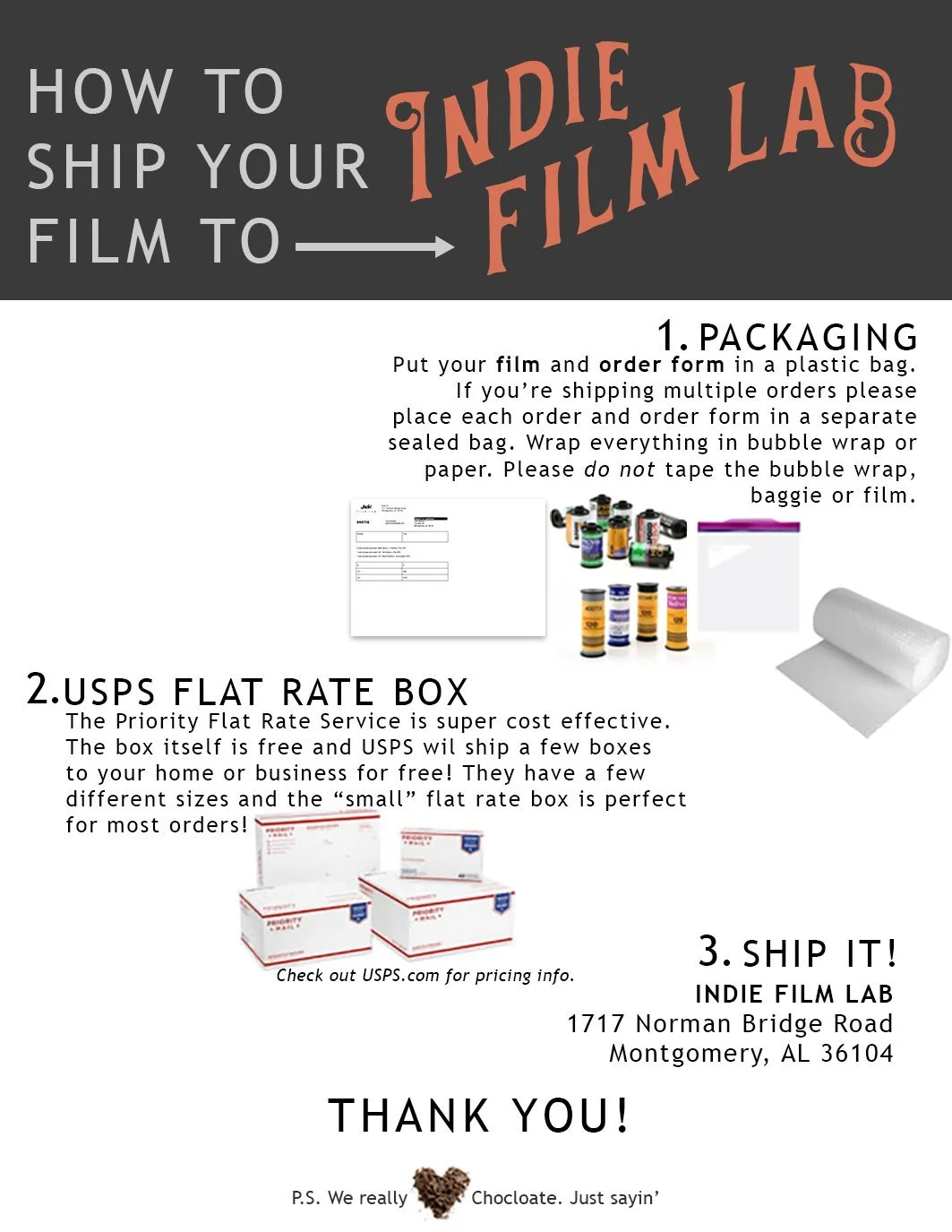
Mail Day!
We have USPS, Fed Ex and UPS deliver daily so any method you prefer is totally fine with us!
When we return negatives to you it will be shipped USPS.
Step 4: We Do Our Thing
Once your film arrives at the lab, here’s what happens behind the scenes:
1. Check-in. Your package is opened, your rolls are matched to your order, and you get a “your film has arrived” notification.
2. Processing. Your film goes through the appropriate chemistry. C-41 for color negative, E-6 for slide film, or B&W chemistry for black-and-white stocks. Temperature, timing, and chemistry strength are all carefully monitored. (E6 is sent to our partner lab for proper E6 development)
3. Scanning and Color Corrections. After processing, your negatives are scanned frame by frame on professional-grade scanners. If you ordered pro corrected scans, a technician adjusts each image individually for optimal color and exposure.
4. Delivery. Your scans are uploaded to a secure online gallery where you can preview, download, and share your images.
Step 5: Get Your Scans (and Your Negatives)
When your scans are ready, you’ll get a notification with a link to view and download your images. Most labs deliver scans as high-resolution JPEG files, with TIFF options available if you need them. Want your negatives back? They’ll be sleeved, protected, and shipped back to you. Hold onto those negatives, they’re the original, and you can always re-scan them down the road for even higher resolution.
What About Turnaround Time?
This is probably the number one question we get, and it’s a fair one. Turnaround varies by lab and by season.
At Indie Film Lab, during our non-peak season (roughly January through May), orders of 1–25 rolls typically come back in 5–7 business days from the time your film arrives. During peak season (June through November), turnaround times may be extended so feel free to reach out at any time and ask us for an update. That’s when wedding and portrait photographers are sending in a LOT of film, and we want to give every roll the attention it deserves. If you’re in a rush, we offer rush processing for an additional fee. Just make sure to submit rush rolls as a separate order so they can be prioritized.
Choosing the Right Scan Options
If you’re new to this, scan options can feel a little overwhelming. Here’s the quick breakdown:
Uncorrected scans are run through the scanner on auto settings with no frame-by-frame adjustments. They’re a budget-friendly option and work well if you plan to do your own color work in Lightroom or Photoshop.
Pro corrected scans mean a real human looks at every single frame and makes color and density adjustments. This is where the magic happens and you get back images that look the way the scene actually felt. For most photographers, especially those shooting client work, pro corrected scans are worth every penny.
Scanner choice is another consideration. Labs that run both Noritsu and Frontier scanners (like we do) let you choose based on your preferred aesthetic. The Noritsu tends to produce slightly warmer tones, while the Frontier leans a touch cooler with more contrast. Both are excellent, it’s really about personal preference.
Tips for Getting the Best Results from Your Film Lab
After years of processing film for photographers all over the world, here’s what we’ve learned makes the biggest difference:
Expose your film well. Film loves light, especially color negative. When in doubt, overexpose by a stop. Your lab will thank you, and your scans will be gorgeous.
Be specific with your order. If you want something pushed, pulled, or handled a certain way, note it clearly. The more information your lab has, the better your results.
Communicate. Have a question? Ask! Shoot an email before you ship if you’re unsure about anything. A good lab wants to hear from you.
Be consistent. Find a lab you trust and stick with them. Your lab gets to know your style over time, and that relationship makes a real difference in your scans.
Can I Mail Film from Outside the US?
A lot of folks wonder about this, and the answer is yes. International photographers mail film to US-based labs all the time. Just keep in mind that international shipping can come with additional duties or shipping costs, and turnaround will be a bit longer due to transit time.
Can I Send Disposable Cameras?
You bet. Disposable cameras are processed just like regular 35mm film. When you place your order, select 35mm as your film size. Send the whole camera — the lab will crack it open and extract the roll. Easy. We actually wrote a whole post on this: Disposable Cameras: What to Buy & How to Develop. Check it out if you want the full rundown.
Ready to Send Your First (or Next) Roll?
That’s really all there is to it. Place your order, pack your film, drop it in the mail, and let us handle the rest. The hardest part is waiting for your scans to come back but trust us, that moment when you open your gallery and see your images for the first time? Nothing beats it.
We’ve been developing, scanning, and printing film out of Montgomery, Alabama since 2011, and we work with photographers from all 50 states and beyond. Whether it’s your first roll or you’re shipping us film every week, we treat every single roll like it matters.
Ready to send your film? Head to our Send Film page, place your order, and let’s get those rolls in the mail.
#longlivefilm
Frequently Asked Questions About Mail-In Film Developing
How much does it cost to mail film to a lab for developing?
Pricing varies by lab and depends on your film format, scan size, and correction level. Most professional labs charge between $10–$25 per roll for developing and scanning. Check out our prices here
Is it safe to mail film through USPS?
Yes. Photographers ship film through USPS every day without issues. Standard postal X-ray screening does not affect most film stocks (ISO 800 and under). Use a padded mailer or small box for extra protection.
How long does mail-in film developing take?
Turnaround depends on the lab and the time of year. At Indie Film Lab, non-peak turnaround for up to 25 rolls is typically 5–7 business days after your film arrives. Peak season (June–November) may take longer.
Can I mail 120 film, large format, and other formats?
Yes! We accept 35mm, 120, and sheet film up to 8x10. We can also process specialty formats like 620, 127, 110, and APS.
What’s the difference between Noritsu and Frontier scans?
Both are professional-grade film scanners. The Noritsu HS-1800 tends to produce warmer tones, while the Fuji Frontier SP-3000 leans slightly cooler with more contrast. Both deliver excellent results, it comes down to personal preference.
Do I get my negatives back?
Yes. Your negatives are sleeved and shipped back to you if you choose the “Return” option when placing your order online.